By Cameron Strachan · 12 min read · With references
The Great Golf Instruction Pissing Contest
How golf became a competition to see who knows the most - while the golfer just wants to hit the bloody ball.
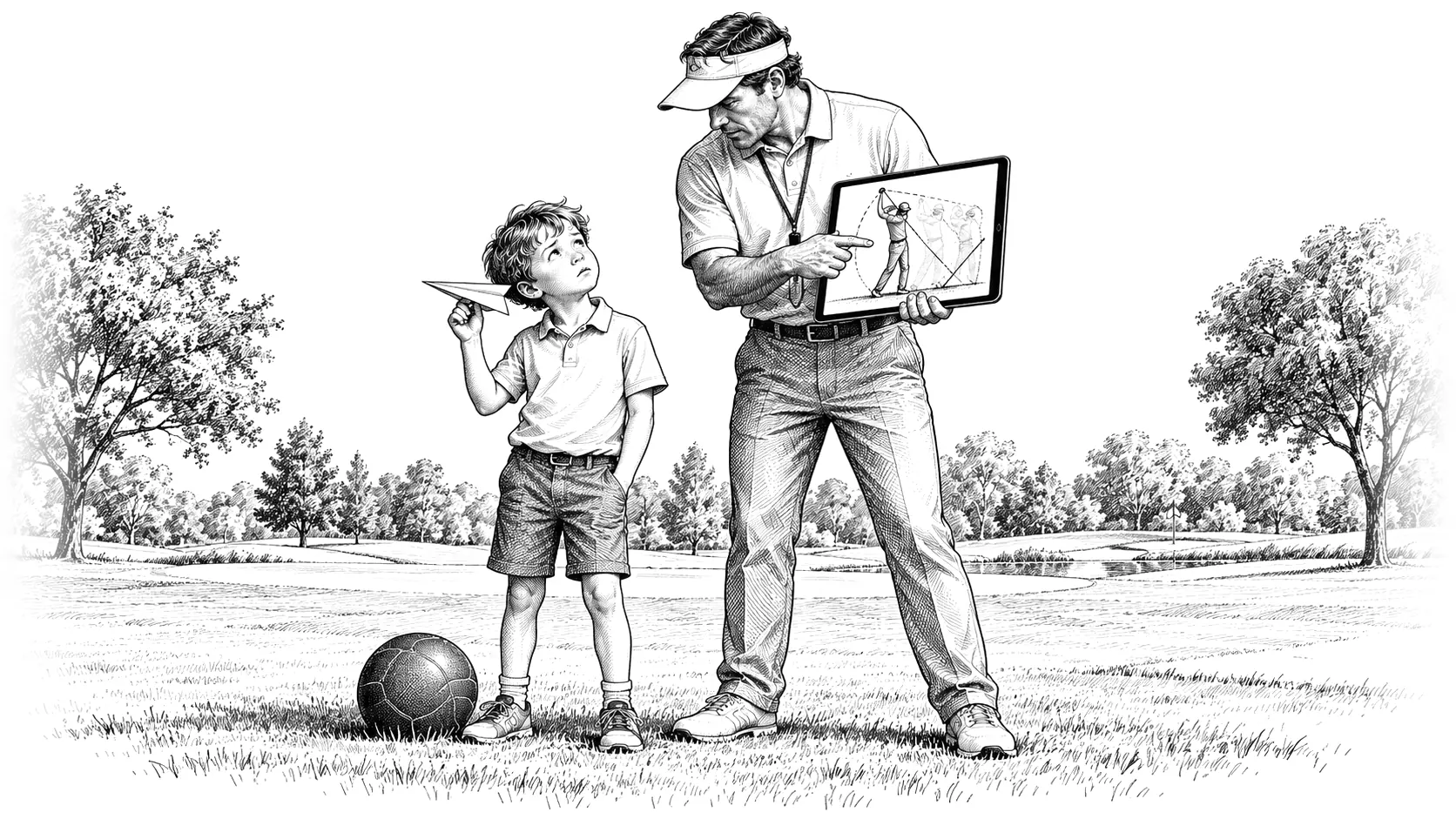
Imagine taking a seven-year-old kid to the park.
He’s got a paper plane.
He’s excited.
He wants to throw it as far as he can.
But just as he’s about to launch it, you stop him.
“Hang on, mate. Not so fast.”
“Before you throw that plane, we need to talk about how your feet interact with the ground.”
You explain ground reaction forces.
How he needs to shift his pressure.
How he needs to rotate his hips.
How he needs to push against the ground to generate power.
You might even pull out your iPad and show him some slow-motion footage of an expert paper-plane thrower.
“See how his pelvis rotates before his upper body? That’s what we’re looking for.”
Then you hand him a medicine ball.
“Righto. I want you to throw this against the ground ten times so you can FEEL how to use your body properly.”
The poor kid looks at you like you’ve lost your mind.
He just wants to throw his bloody paper plane.
And, of course, you’d never dream of doing this.
You’d let him throw it.
He’d watch it fly.
Maybe it would nosedive.
Maybe it would turn left.
Maybe it would fly beautifully.
He’d pick it up and try again.
He’d experiment. Make adjustments. Discover what works.
And over time, he’d probably get better at throwing paper planes.
Without knowing a single thing about ground reaction forces.
Without consciously controlling his pelvis.
And without throwing a medicine ball.
Now here’s my question.
Why do we make golf so much more complicated?
Because when you strip away the scientific terminology, the sophisticated equipment and the endless explanations, we’re doing something remarkably similar to golfers.
And I think it’s time we talked about it.
The Great Golf Instruction Pissing Contest
I’ve been involved in golf coaching for a long time.
And I’ve watched something rather extraordinary happen.
We’ve developed an almost unbelievable ability to measure, analyze and explain the golf swing.
We’ve got high-speed cameras.
Launch monitors.
Force plates.
3D motion capture.
Pressure mapping.
Computer-generated swing models.
And increasingly sophisticated ways of measuring what almost every part of the human body is doing during a golf swing.
It’s fascinating stuff.
I mean that sincerely.
But somewhere along the way, I think we’ve confused two very different things.
Understanding how the golf swing works and helping someone become better at golf.
They’re not the same.
And I believe the golf instruction industry has become caught up in something resembling a giant pissing contest.
Who knows the most?
Who has the best technology?
Who can identify the most obscure movement?
Who can produce the most sophisticated explanation?
Who has discovered the latest secret to power, accuracy or consistency?
And who can make a 25-minute YouTube video about something that might not need explaining at all?
The problem isn’t necessarily that the information is wrong.
Much of it may be perfectly accurate.
The problem is the assumption that because something can be explained, it needs to be explained to the golfer.
And because it sounds important, the golfer assumes it must be important to their improvement.
That’s where things start going off the rails.
Nobody Asked Billy
Let’s consider what the average golfer actually wants.
He’s not lying awake at night wondering whether his lead-side vertical ground reaction force is peaking at the optimal moment.
He’s not worried about whether his pelvis is rotating three degrees too slowly.
He’s not particularly interested in his proximal-to-distal kinetic sequence.
He’s wondering why he missed that bloody four-foot putt on the 17th.
He’s thinking about the drive he smashed down the middle of the fairway.
He’s remembering the seven-iron he flushed onto the green.
And he’s wondering whether this Saturday might finally be the day he takes $20 off Billy.
Because Billy’s been taking his money for six months.
That’s golf.
The golfer wants to hit better shots.
Make a few birdies.
Stop losing balls.
Play with more confidence.
Have some fun.
And occasionally walk into the clubhouse feeling like a champion.
Yet the instruction industry keeps finding new ways to explain the mechanics of the golf swing.
And I wonder whether we’ve stopped asking the most important question of all.
What does the golfer actually want?
More information?
Another theory?
Another swing position?
Or the ability to hit a better shot once in a while?
When More Information Feels Like Better Teaching
Here’s where things get particularly interesting.
I don’t believe most golf teachers are deliberately making the game complicated.
Quite the opposite.
I suspect many genuinely believe they’re helping.
They study biomechanics.
They attend seminars.
They invest in technology.
They discover new measurements and movement patterns.
And naturally, they want to share that knowledge with their golfers.
That sounds reasonable.
But there’s a potential problem.
The teacher can become so fascinated by what they’ve discovered that they forget to ask whether the golfer needs to know it.
And the golfer isn’t necessarily going to challenge them.
After all, the teacher sounds incredibly knowledgeable.
They’ve got the technology.
They’ve got the graphs.
They’ve got the qualifications.
They’ve got the scientific terminology.
Surely all this information must be helping?
Not necessarily.
Psychologists have studied several tendencies that help explain why complicated explanations can appear more convincing than they deserve.
One is authority bias.
We’re inclined to place greater trust in people we perceive as experts.1
Another is the seductive allure of scientific explanations.
Research has shown that adding scientific-sounding information can sometimes make an explanation seem more satisfying, even when that information adds little to its actual value.2,3
And then there’s the tendency to assume that complicated problems require complicated solutions.
Put these together and you have an interesting situation.
The teacher delivers an elaborate explanation.
The golfer is impressed.
The teacher feels they’ve delivered a valuable lesson.
The golfer feels they’ve learned something.
Everyone leaves happy.
But there’s one question that hasn’t necessarily been answered.
Can the golfer actually play better golf?
The Difference Between Knowing and Doing
This is something I believe the golf industry needs to understand.
Knowing more about a movement doesn’t automatically make you better at performing it.
You can understand the biomechanics of throwing a ball without being particularly good at throwing.
You can study the mechanics of running without becoming a faster runner.
You can know everything about swimming technique and still struggle in the water.
Golf is no different.
There’s a distinction between knowledge about a skill and the ability to perform that skill.
And motor-learning research makes another important distinction.
Performance during practice isn’t necessarily the same as learning.4
A golfer might make a movement successfully during a lesson.
They might hit a few excellent shots while the teacher provides constant feedback.
They might even reproduce the exact position they’ve been working on.
But what happens three days later?
What happens when the teacher isn’t there?
What happens when they’re standing on the first tee with three mates watching?
What happens when they’re playing for their monthly medal?5
That’s when we begin to discover whether the learning has transferred.6
And that’s the outcome I’m interested in.
Not whether a golfer can reproduce a movement on command.
But whether they can play golf.
Ground Reaction Forces: A Perfect Example
Let’s talk about one of the more fashionable subjects in golf instruction.
Ground reaction forces.
GRF.
Now, before anyone gets upset, I’m not suggesting ground reaction forces aren’t real.
Of course they are.
When we interact with the ground, forces are exchanged.
Those forces contribute to how we move, accelerate, rotate and maintain balance.
Researchers can measure them.
And studying them can provide useful information about how golfers produce powerful swings.
Wonderful.
But here’s where I start questioning things.
Somewhere between measuring ground reaction forces and teaching golfers, we’ve developed exercises designed to help golfers consciously manipulate how they interact with the ground.
Medicine-ball throws.
Pressure-shift rehearsals.
Footwork exercises.
Rotational movements.
All designed, at least in some cases, to help golfers reproduce particular movement patterns.
And I find myself asking:
Why?
Not because these exercises can never be useful.
They may be valuable for physical conditioning, rehabilitation or specific performance objectives.
But if the goal is to help someone strike a golf ball more effectively, shouldn’t we establish whether these exercises actually improve that skill?
And whether the improvement transfers to the golf course?
And whether the same outcome might be achieved more simply?
Because here’s something worth remembering.
The golfer is already interacting with the ground every time they swing a club.
They cannot avoid it.
The question isn’t whether ground reaction forces exist.
The question is whether the golfer needs to consciously think about them.7
Those are two entirely different things.
And confusing them is a perfect example of what I believe has gone wrong with modern golf instruction.
We’ve Confused Observation With Instruction
Imagine watching an elite golfer in slow motion.
You see the hips rotate.
The shoulders turn.
The pressure shift.
The wrists move.
The body stabilize.
The club accelerate.
It’s extraordinary.
But then something happens.
We start turning those observations into instructions.
“Rotate your hips like this.”
“Shift your pressure here.”
“Maintain this wrist angle.”
“Get into this position.”
“Sequence your body in this order.”
And suddenly, the golfer is trying to consciously reproduce movements that may have emerged through years of practice and adaptation.
Just because an elite golfer’s body does something doesn’t mean an amateur needs to consciously make their body do the same thing.
That is a massive assumption.
And it’s one I believe deserves far more scrutiny.
The elite golfer may not be consciously thinking about any of those movements.
They may simply be trying to hit a particular shot.
The body is doing what it has learned to do.
Yet we look at the movement, break it into pieces and hand those pieces to the amateur as a list of instructions.
Then we wonder why the amateur struggles.
The Golf Expertise Illusion
I’ve started thinking about this problem as something I’d call The Golf Expertise Illusion.
It’s not a new scientific law.
It’s my name for a pattern I believe exists throughout golf instruction.
- The Golf Expertise Illusion
- The tendency to mistake sophisticated explanations of the golf swing for effective golf coaching.
The teacher sounds convincing.
The information sounds scientific.
The technology looks impressive.
And the golfer assumes they’re receiving something valuable.
Sometimes they are.
But not always.
And that’s the distinction.
A teacher can be exceptionally knowledgeable about biomechanics without necessarily being effective at helping a particular golfer develop skill.
Likewise, a coach might deliver a remarkably simple instruction that produces meaningful improvement.
The complexity of the explanation doesn’t establish its value.
The outcome matters.
And I think we’ve lost sight of that.
The Problem With Good Intentions
Here’s the part I find most concerning.
The teacher genuinely believes they’re helping.
The golfer genuinely believes they’re learning.
And the content creator sees people responding positively to increasingly sophisticated information.
So what happens?
More content.
More analysis.
More detail.
More obscure movements.
More explanations.
More things for golfers to think about.
The teacher receives positive feedback and produces more of the same.
The golfer encounters another explanation and assumes they’ve discovered another missing piece of their swing.
And the cycle continues.
The industry gets better at producing information while the golfer risks becoming increasingly dependent on it.
It’s a self-reinforcing problem.
And it doesn’t require anyone to be dishonest.
In fact, good intentions can help keep the cycle going.
But good intentions don’t automatically produce good coaching.
And I think we need to be prepared to say that.
Politely.
Professionally.
But clearly.
What If We Just Let Golfers Swing?
Let’s return to the kid with the paper plane.
He doesn’t need to understand everything his body does during the throw.
He needs a clear objective.
He needs an opportunity to act.
He needs feedback from what happens.
And he needs enough attempts to learn.
His movement system can begin organizing itself around the task.
That doesn’t mean every movement will be perfect.
It doesn’t mean coaching is unnecessary.
And it certainly doesn’t mean learning happens instantly.
But it does demonstrate something important.
A movement can be mechanically complicated without requiring a complicated conscious intention.
And that’s the foundation of my approach to golf.
I’ve spent years exploring the idea that the golf swing can be approached as a two-handed throwing motion.
Rather than asking golfers to consciously control dozens of body movements, I start with one basic idea.8,9,10
The golf swing is a throwing motion. Full stop.
Then I encourage them to explore, practice, adapt and learn.
The body still moves.
The hips still rotate.
The ground still contributes.
The wrists still function.
All the complicated biomechanics are still there.
But the golfer doesn’t necessarily need to consciously manufacture them.
That’s the difference.
And in my own golf, committing to this simple intention has coincided with some of the best golf I’ve ever played.
Not because I’ve discovered a secret biomechanical position.
But because I’ve stopped trying to consciously control so much of the movement.
What UNFK Golf Stands For
I think it’s time we were clear about this.
UNFK Golf isn’t anti-science.
We’re not anti-technology.
We’re not suggesting biomechanics are irrelevant.
And we’re certainly not suggesting that all technical teaching is useless.
But we challenge the assumption that understanding more about the mechanics of the golf swing necessarily makes someone better at performing it.
We believe golfers need clear intentions.
Opportunities to practice.
Useful feedback.
Time to adapt.
And coaching that helps them become increasingly capable and independent.
We believe the purpose of coaching is to develop the golfer’s ability to play golf.
Not simply their ability to describe a golf swing.
We don’t judge coaching by how much information the coach delivers. We judge it by what the golfer becomes capable of doing.
Can they hit better shots?
Can they adapt?
Can they perform under pressure?
Can they make better decisions?
Can they enjoy the game more?
Can they play without constantly worrying about their body positions?
Those are the questions that interest me.
And if the answer is yes, I don’t particularly care whether the golfer understands ground reaction forces.
The Billy Test
In fact, I’ve got a much simpler way of evaluating golf instruction.
I call it The Billy Test.
It’s straightforward.
- The Billy Test
- Will this ultimately help me beat Billy on Saturday?
Now, I don’t mean every lesson needs to produce an immediate improvement.
Learning takes time.
And sometimes we need to work through difficult things before performance improves.
But the objective should remain clear.
The golfer wants to become better at playing golf.
Not simply better at understanding golf instruction.
So the next time someone introduces another complicated movement, another biomechanical theory or another elaborate exercise, ask yourself:
Will this actually help me play better?
Or am I just collecting more information?
Because those aren’t the same thing.
Let the Kid Throw the Bloody Plane
I keep coming back to that seven-year-old.
Standing in the park.
Holding his paper plane.
Waiting for permission to throw it.
And I can’t help thinking about the thousands of golfers who stand over the ball every weekend, trying to remember everything they’ve been told.
Turn the hips.
Shift the pressure.
Maintain the angle.
Keep the head still.
Don’t flip the wrists.
Shallow the club.
Rotate through.
Don’t come over the top.
And somewhere in all that noise, they’ve forgotten what they were trying to do in the first place.
Hit the ball.
Towards a target.
And enjoy themselves.
We’ve become so obsessed with how the body produces the golf swing that we’ve forgotten to let golfers actually swing.
That’s what I believe needs to change.
And that’s why I wrote The Golf Lie.
Not to give golfers another complicated swing theory.
But to challenge the belief that they need to consciously control every part of their swing to play good golf.
Because maybe the answer isn’t another explanation.
Maybe it isn’t another drill.
Maybe it isn’t another swing position.
Maybe we need to stop treating golfers like engineering projects.
Give them a club.
Give them a target.
Give them a clear intention.
And help them learn.
The golf industry can keep arguing about who understands the swing best. I’d rather help golfers play better golf.
And maybe, just maybe, finally take that twenty bucks off Billy.
The research
- 1
People judged the same article fairer, and were more persuaded by it, when they believed it came from a credible source.
Hovland, C. I., & Weiss, W. (1951). The influence of source credibility on communication effectiveness. Public Opinion Quarterly, 15(4), 635-650. doi.org/10.1086/266350
- 2
Adding irrelevant neuroscience made bad explanations more satisfying to non-experts. Experts weren’t fooled.
Weisberg, D. S., Keil, F. C., Goodstein, J., Rawson, E., & Gray, J. R. (2008). The seductive allure of neuroscience explanations. Journal of Cognitive Neuroscience, 20(3), 470-477. doi.org/10.1162/jocn.2008.20040
- 3
It isn’t just neuroscience. Across several sciences, explanations padded with irrelevant “deeper” scientific detail were rated as better.
Hopkins, E. J., Weisberg, D. S., & Taylor, J. C. V. (2016). The seductive allure is a reductive allure: People prefer scientific explanations that contain logically irrelevant reductive information. Cognition, 155, 67-76. doi.org/10.1016/j.cognition.2016.06.011
- 4
How well someone performs during practice is an unreliable guide to how much they have actually learned.
Soderstrom, N. C., & Bjork, R. A. (2015). Learning versus performance: An integrative review. Perspectives on Psychological Science, 10(2), 176-199. doi.org/10.1177/1745691615569000
- 5
People who learned to putt from explicit technical rules held up worse under pressure than people who learned without them.
Masters, R. S. W. (1992). Knowledge, knerves and know-how: The role of explicit versus implicit knowledge in the breakdown of a complex motor skill under pressure. British Journal of Psychology, 83(3), 343-358. doi.org/10.1111/j.2044-8295.1992.tb02446.x
- 6
Practice that looks good on the day can produce worse long-term learning, and the reverse. Learning shows up later, in retention and transfer.
Schmidt, R. A., & Bjork, R. A. (1992). New conceptualizations of practice: Common principles in three paradigms suggest new concepts for training. Psychological Science, 3(4), 207-217. doi.org/10.1111/j.1467-9280.1992.tb00029.x
- 7
Well-practiced skills can break down when people start consciously monitoring and controlling their movements. Pressure is a common trigger.
Masters, R. S. W., & Maxwell, J. P. (2008). The theory of reinvestment. International Review of Sport and Exercise Psychology, 1(2), 160-183. doi.org/10.1080/17509840802287218
- 8
People learning a golf shot were more accurate, in practice and in a retention test the next day, when they focused on the club’s swing rather than their arm swing.
Wulf, G., Lauterbach, B., & Toole, T. (1999). The learning advantages of an external focus of attention in golf. Research Quarterly for Exercise and Sport, 70(2), 120-126. doi.org/10.1080/02701367.1999.10608029
- 9
Focusing on the club’s motion rather than the arms made golf shots more accurate, for beginners and for experienced golfers.
Wulf, G., & Su, J. (2007). An external focus of attention enhances golf shot accuracy in beginners and experts. Research Quarterly for Exercise and Sport, 78(4), 384-389. doi.org/10.1080/02701367.2007.10599436
- 10
Fifteen years of studies: focusing on the effect of a movement, rather than on the body, consistently improved both performance and learning.
Wulf, G. (2013). Attentional focus and motor learning: A review of 15 years. International Review of Sport and Exercise Psychology, 6(1), 77-104. doi.org/10.1080/1750984X.2012.723728
Want to Experience the UNFK Way?
You don't need to study movement science to benefit from it.
In The Golf Lie, I explain why conventional golf instruction has become so complicated and introduce a much simpler way to approach your swing.
Or start with our free introductory lessons.
No spam. No bullshit. Unsubscribe anytime.